
Probate & trust sales · Complete guide
The Sacramento Seller Guide for Probate & Inherited Property.
A plain-language, 18-chapter guide for Sacramento executors, administrators, successor trustees, heirs, and families handling an inherited home in California. It covers the real estate side of the process: authority, title, what the property needs, and which professionals should be involved.
Last reviewed: October 16, 2026
When a loved one passes away, the home can be one of the largest and most emotional decisions the family handles. This guide is written for the people in the middle of that decision: the executor or administrator appointed by the court, the successor trustee named in a trust, and the heirs who are trying to understand what happens next. It explains who holds authority, how title shapes the legal path, what the property needs before it can be listed, and which professionals should be involved, in warm, calm, plain language. It is general real estate education, not legal, tax, or probate advice.
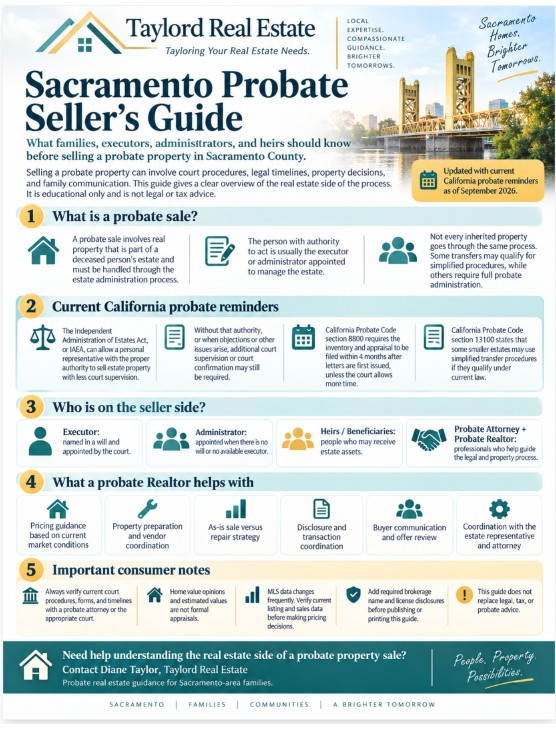
Free downloadable guides
Get the Free Sacramento Seller Guides
Keep the one-page printable infographic close by as your family works through the process, and grab the Sacramento Seller's Guide for Probate & Inherited Property (October 2026) as your family's deeper reference. Your name plus an email address or phone number unlocks both downloads.
No spam, ever. We only use your info to send these guides and answer your property questions.
Thank you! Here are your free guides.
Chapter 1
Welcome and Purpose of This Guide
When a loved one passes away, the family home can become one of the largest and most emotional decisions the family will handle. Rooms hold decades of memories, and the house itself is often the family's biggest asset. This guide exists so that decision does not have to happen in the dark.
The guide focuses on the real estate side of that decision: who holds the authority to act, how the property is titled, what the property needs before it can be listed or sold, and which professionals should be involved at each step. Legal questions belong to the attorney, tax questions belong to the CPA, and the real estate process belongs to a team that knows estate sales. This guide is general real estate education and is not a substitute for qualified legal, tax, insurance, or financial advice.
Chapter 2
Probate in Plain English
Probate is the court-supervised process California uses to manage and transfer a deceased person's assets when those assets do not transfer automatically through a trust, title, a beneficiary designation, or another legally available procedure. The court oversees the process to protect creditors, heirs, and the integrity of the estate.
Two phrases cause the most confusion: "a will avoids probate," and "the will names me executor, so I can sell the house." Neither is automatically true. A will does not by itself avoid probate; it names who the family believes should manage the estate, but the court makes the appointment. Being named in a will as executor does not by itself create authority to sell. Authority comes from the court's appointment documents, not from the will itself.
For quick answers to the questions Sacramento families ask first, see the Probate FAQ for Sacramento Families .
Chapter 3
Start With Title: Does the Home Need Probate?
The single most important question is not "is there a will?" It is "how is the home held on title?" How the property is held on title determines the legal path, and the deed, not the family's memory, controls. Every path below starts the same way: get a copy of the current deed and have qualified counsel confirm the rule for your situation.
| How title reads | What it usually means |
|---|---|
| Home in a living trust | Trust administration, if the trustee's authority is properly documented. |
| Joint tenancy / survivorship | May pass to the surviving owner outside formal probate, subject to title and legal requirements. |
| Titled only in the decedent's name | Formal probate or another court procedure may be required. |
| Tenants in common | The decedent's share does not automatically pass to the co-owner. |
| Meant for the trust, but title does not show it | An attorney should review the options before the family assumes the trust handles everything. |
A note on smaller estates: for deaths on or after April 1, 2025, California provides a simplified court petition that may be available for a decedent's California primary residence valued at $750,000 or less, if all legal requirements are met. Separate small-estate procedures also exist for personal property and for very low-value real property. Confirm the current deed and ask qualified counsel which transfer procedure applies to the family's situation.
The deeper breakdown of whether formal probate is needed, who holds authority, and how the two big paths compare lives in Sacramento Probate & Inherited Property Real Estate .
Chapter 4
Who Does What in a Probate or Trust Sale
Selling an estate property is a team effort, and each member has a specific job. Knowing who does what reduces confusion, prevents costly duplication, and keeps the family focused on the decisions that belong to them.
| Role | What they do |
|---|---|
| Personal Representative | The court-appointed executor or administrator who manages the estate, protects its assets, follows court requirements, and guides the process through to distribution. |
| Successor Trustee | The person named in a living trust who manages trust-owned property under the terms of the trust document. |
| Probate or Trust Attorney | Establishes legal authority, handles court procedures, prepares notices and petitions, manages creditor issues, and resolves disputes. |
| Probate Referee | A court-appointed appraiser who values certain probate assets for the Inventory and Appraisal. |
| Escrow and Title | Handle the transfer of money and title, clear title requirements and liens, and manage closing conditions. |
| Real Estate Broker/Agent | Provides market evaluation, sale choices, preparation, marketing, offer review, and the day-to-day organization of the property transaction. |
One line from the book is worth memorizing: the real estate professional coordinates the property transaction, but legal authority, beneficiary rights, court procedures, tax advice, and estate distributions belong with the appropriate attorney, CPA, court, or other professional.
Chapter 5
California Probate Roadmap: Three Main Phases
Formal probate happens in three broad phases. Families who understand the phases know where they are on the map and what comes next.
| Phase | What happens |
|---|---|
| Phase 1: Open the case and appoint the personal representative | A petition is filed, notice goes out, a hearing is held, and the personal representative is appointed. A bond is posted if required, and the documents that prove authority are issued. |
| Phase 2: Administer the estate | Assets are identified and valued, creditors are handled, and taxes are addressed. The property may be managed or sold during this phase, which is usually the main real estate phase. |
| Phase 3: Close the estate and distribute | The personal representative reports to the court, receives approval, and makes the court-authorized distribution to the heirs. |
How long does it take? California Courts describes formal probate as typically taking about 9 to 18 months, and longer sometimes. A home sale can be finished before probate itself is finished, and heirs may wait for court-authorized distribution. A fast sale does not mean the estate closes the same day.
Why probate can feel slow
- Court calendars: hearings are scheduled around the court's docket, and a missed filing date can add weeks.
- Required notices and creditor procedures: California gives creditors a set window to file claims, and everyone entitled to notice must be properly served.
- Missing documents, objections, title problems, or disputes: any of these pauses the clock while they are resolved.
- A sale and final distribution are separate events: the home can sell and close, but the estate remains open until the court approves the accounting and the distribution.
Chapter 6
Before the Home Can Be Listed: Authority and Court Documents
None of the real estate work can begin with legal authority. Here is the order in which that authority is established, in plain English:
- 1 A petition is filed asking the court to open the estate and appoint the personal representative.
- 2 Heirs and other interested persons receive notice, and publication may be required.
- 3 The court holds a hearing on the petition.
- 4 If approved, the court enters an Order for Probate.
- 5 Letters (form DE-150) are issued, proving the official appointment.
- 6 A bond may be required before the appointment takes effect.
Two documents families hear about
Document 1
Order for Probate
Confirms the court's approval of the appointment. It may state bond requirements and the level of independent authority the personal representative holds.
Document 2
Letters (DE-150)
Proves the official appointment. It shows whether the personal representative holds full or limited authority under the Independent Administration of Estates Act (IAEA).
Useful work you can do while waiting
- Secure the property and protect it from weather, theft, and hazards.
- Gather documents: will, trust, deed, death certificate, mortgage, and title information.
- Review the condition of the home, inside and out.
- Request current market information for the property.
- Talk through sale options with the family and your real estate professional.
- Identify vendors, contractors, and services you are likely to need.
Do not sign or market the property as if authority already exists. A listing agreement signed without authority can create real problems for the estate, the buyer, and the person who signed.
Chapter 7
Executor and Administrator Checklist
This checklist comes straight from the book. It is organized the way the work actually happens: authority first, then protecting the property, then preparing for a sale.
Authority and documents
- Locate the will, trust, deed, death certificate, mortgage, title information, and any court documents.
- Confirm whether formal probate or another procedure is required.
- Confirm who has authority and obtain copies of Letters or other orders.
- Ask whether the authority is full, limited, or restricted.
Property and cash-flow protection
- Confirm who is occupying the property and any tenant or legal rights.
- Verify insurance and vacancy requirements.
- Keep utilities, taxes, HOA, mortgage payments, and services organized.
- Protect valuables, mail, records, photos, keys, and access devices.
Sale readiness
- Request a current market-value and condition review.
- Compare as-is, targeted repair, full preparation, keep, or rent.
- Get vendor estimates only after authority, budget, and strategy are clear.
- Keep records of estimates, approvals, invoices, and decisions.
Remember that the personal representative is managing someone else's estate. Clear records reduce confusion for the family, the attorney, the court, and tax season.
Working through this in order? The free Sacramento Probate Checklist turns these groups into a simple 10-step plan.
Chapter 8
Successor Trustee Guide
Trust administration and probate are not the same process, and the difference changes who can act and what the court requires. Before any listing conversation begins, confirm these five things:
- 1 Is the property actually titled in the trust?
- 2 Who is the acting successor trustee?
- 3 Are there co-trustees or joint-signature requirements?
- 4 Can the title company verify the trustee's authority?
- 5 Does counsel need to review beneficiary notices?
If something does not match
Any of the following means the family should pause and get legal guidance before spending time or money on the property:
- The trust document is missing.
- The deed is still in the decedent's name.
- The property was removed from the trust for a refinance and never retitled.
- The trust terms are unclear.
- The named trustee is unavailable, deceased, unwilling, or disputed.
If the property was intended for the trust but was left out, an attorney may evaluate whether a court petition can confirm the property belongs to the trust instead of full probate. That review should happen before the family invests in preparing the home.
“We have a trust” is not enough if the title and the trust documents do not line up. The deed and the trust together determine the path.
For a side-by-side look at probate versus trust sales, see Probate and Trust Sales: A Family Guide .
Chapter 9
First 72 Hours: Secure and Stabilize the Property
The first three days are about protection, not decisions. Careful habits now prevent expensive surprises later:
- Do an exterior and interior safety review, if access is authorized.
- Confirm who is living in the home, and do not remove an occupant or change locks without confirming legal rights and authority.
- Secure keys, gates, garage remotes, alarm information, and access codes.
- Contact the insurance professional about the death, vacancy, and occupancy.
- Keep necessary utilities active.
- Address obvious water, electrical, fire, pest, and trip hazards.
- Photograph the property and significant contents before moving, donating, selling, or discarding items.
- Forward urgent notices (foreclosure, reverse-mortgage, tax, HOA, insurance, code enforcement) to the appropriate attorney or professional right away.
Do not rush the clean-out. Important documents, valuables, and other people's property may be mixed in with everyday items. Sorting carefully protects the estate and the family.
Chapter 10
Preparing the Property and Choosing a Sale Strategy
Preparation happens in five steps, in order:
- 1 Stabilize: Stop new damage and secure the property against weather, theft, and hazards.
- 2 Sort: Separate documents, valuables, and personal property so nothing important is lost.
- 3 Evaluate: Get a current market-value and condition review of the home.
- 4 Compare: Run the numbers on the main sale choices below, including timing and workload.
- 5 Launch: Prepare the property and list, once the authority documents are in hand.
The common sale choices
| Choice | What to know |
|---|---|
| Sell As-Is on the MLS | Best for broad market exposure without major repairs. Buyers may discount for condition, and disclosures and inspections still matter. |
| Targeted Repairs + List | Limited improvements likely to improve marketability or net proceeds. |
| Investor / Cash Offer | Speed, simplicity, or heavy repairs. The price may be lower than a well-exposed open-market sale. |
| Keep or Rent | For when beneficiaries agree and legal, financing, tax, insurance, and management issues are workable. Creates ongoing management, tax, maintenance, and family responsibilities. |
Compare net proceeds, timing, workload, risk, authority, and family goals, not just sale price. The best choice is the one that fits the estate's legal position and the family's priorities.
The step-by-step order of the sale itself is covered in How to Sell a House in Probate in California .
Chapter 11
Selling Authority, Court Confirmation, and Appraisals
Authority shapes the sale procedure, and different values serve different purposes. This chapter separates the three so offers are not structured on the wrong assumption.
Full IAEA authority
With full authority under the Independent Administration of Estates Act, a sale may often proceed without a separate court-confirmation hearing. The personal representative still follows the estate's notice and objection process, and a Notice of Proposed Action may be required before the sale is completed.
Limited IAEA authority
With limited authority, the personal representative has no independent authority to sell real property. Pricing, deposit, hearing, and possible overbid rules may affect the buyer and the timeline. An objection can change the path, and court confirmation procedures may apply.
Three different values, three different jobs
| Value | What it is for |
|---|---|
| Real estate market analysis (CMA) | Assesses current buyer demand, condition, and sale strategy. It is a pricing tool for the list price and for evaluating offers. |
| Probate Referee appraisal / Inventory & Appraisal | Values probate assets for court administration, generally at date-of-death values. It is not a marketing price opinion. |
| Buyer lender appraisal | Values the property for the buyer's lender when the buyer is financing the purchase. |
In court-supervised sales, California probate rules may impose minimum-price, deposit, hearing, and overbid requirements. These are technical and should be confirmed with probate counsel before an offer is structured or accepted. A market value, a probate referee value, and a lender appraisal can all differ because they serve different purposes at different times.
Chapter 12
After Escrow Closes: Where the Money Goes
Understand what happens on the day escrow closes, and what happens after, before the family plans its finances around a single closing date.
At closing
- The buyer receives title after escrow satisfies the closing requirements.
- Approved mortgage payoffs, taxes, liens, title, escrow, and other costs are handled from the sale proceeds.
- Net sale proceeds generally become estate funds rather than being divided immediately among the heirs.
What may continue after closing
- The estate may need a separate EIN and an estate bank account.
- The personal representative continues with creditor claims, expenses, taxes, and records.
- A final report or accounting may be required before distribution.
- The signed distribution order controls when and how the remaining assets are distributed.
- Court approval and actual receipt of funds may not happen the same day.
The home can be sold months before the heirs receive their inheritance. That may simply be the remaining probate administration doing its work; it is not a problem with the sale.
Chapter 13
Common Complications and When to Move Quickly
Every estate has wrinkles, but some are early-warning signals. The items below deserve attention before an offer is accepted, not after.
| Red flag | Handle it early |
|---|---|
| Old liens, unreleased loans, missing deeds, vesting errors, unpaid HOA items | Order title information early. These take time to clear and can delay a closing that otherwise looks clean. |
| Relative or tenant living in the property | Occupancy rights affect access, clean-out, showings, possession, and closing. Do not assume the occupant can simply be removed. |
| Reverse mortgage | Time-sensitive payoff and lender requirements can apply after death. Send lender notices to counsel and begin planning promptly. |
| Notice of Default or trustee sale | Foreclosure deadlines can continue while probate is being addressed. Get legal advice immediately and track every date. |
| No or very little equity | A short sale or other lender approval may be required. Make no commitments before counsel and lender strategy are clear. |
| Heirs disagree | The personal representative and attorney manage authority and disputes. Keep the process factual and documented. |
| Personal representative lives out of state | Plan coordination early, including signatures, documents, and communication. |
Treat these as early-warning issues, not things to solve after an offer is accepted. Ordering title early and putting every notice in front of the attorney immediately heads off the most common closing delays.
Chapter 14
Tax-Aware Questions for Inherited Property
Tax is a chapter on its own because inherited property follows different rules from bought-and-sold property. This is general education; the CPA and the county assessor give the answers for your family.
Inherited property generally gets a basis tied to fair market value at the date of death, often called a step-up in basis, subject to exceptions and elections. In plain terms, families should not assume that decades of appreciation automatically become taxable gain when the inherited home is sold.
California property tax is a separate question. Proposition 19 changed the parent-child and grandparent-grandchild exclusions. The current exclusion is generally limited to a qualifying family home or family farm, with occupancy, value, and filing requirements. The family should evaluate the rules with the county assessor and a tax advisor before assuming an exclusion applies.
For the full walkthrough of assessed values, payment dates, supplemental bills, exemptions, and inherited-home rules, see the Sacramento County Property Tax Guide .
Other items to raise with the professionals
- The decedent's final individual income-tax return.
- A possible estate income-tax return.
- The closing statement and repair invoices, for tax reporting purposes.
- Medi-Cal estate recovery: for deaths on or after January 1, 2017, California limits recovery to certain benefits and probate assets, subject to exemptions and other rules.
Ask the CPA or attorney before deciding to keep, rent, improve, distribute, or sell. The order of the decisions can change the tax result.
Chapter 15
Frequently Asked Questions
The questions families ask the most, answered in plain language:
| Question | Short answer |
|---|---|
| Can the home be sold during probate? | Actually, not every probate sale needs court approval. In California, under the Independent Administration of Estates Act (IAEA), a personal representative who has been granted full authority by the court can sell the property like a traditional sale, with an exception. The court allows 15 additional days to be added to the close of escrow, so that each beneficiary is given enough time to sign the “Notice of Proposed Action”! On the other hand, if the personal representative receives Limited Authority, Court Confirmation will be required. A property being liquidated by a Successor Trustee/s, will move forward a little differently. The trust paperwork must be presented. If it is not presented, you might be looking at a potential Probate. One of the items established in the trust is the identity of the Successor Trustee/s and the beneficiaries. This is critical because it makes known who has the right to sign the legal documentation. Once all the players are identified the trust sale can proceed like most traditional sales. |
| Can we list because the will names me executor? | Not necessarily. Confirm the court appointment and that Letters have been issued before acting as if authority exists. |
| Should we clean out the whole house first? | Not always. Preserve documents and important belongings, stabilize the property, then compare the cost and the likely return of a full clean-out. |
| Why is the probate referee value different from market value? | They serve different purposes and may use different valuation dates. Neither is wrong; they answer different questions. |
| When do heirs get the money? | Usually not at closing. Proceeds may remain estate funds until the remaining administration is complete and the court authorizes distribution. |
| Can one heir stop the sale? | An objection can delay or complicate a sale. The outcome depends on authority, notices, court orders, and beneficiary rights. |
| What if the home is in a trust? | Start with the deed and the trustee's authority. A properly funded trust may avoid formal probate, but mismatches may require legal review. |
| Can Diane help if I live outside California? | Yes. After authority is confirmed, local coordination can include access, condition documentation, vendors, preparation, marketing, offers, and escrow communication. |
When a question turns into "Who has legal power?", "Who inherits?", "Can we evict?", "What tax will we owe?", or "Can the court approve this?", that is the point to involve the appropriate attorney, CPA, assessor, or other professional. More questions and answers are in the Probate FAQ for Sacramento Families .
Chapter 16
Questions to Ask the Probate or Trust Attorney
Bring this list to your first conversation with the estate attorney. Ten questions, and they are the ones that matter:
- Is formal probate required for this property, or is another transfer procedure available?
- Who currently has authority to sign a listing agreement, disclosures, escrow instructions, and sale documents?
- Have the Order for Probate and Letters been issued?
- Does the personal representative have full or limited IAEA authority?
- Is a Notice of Proposed Action required for this sale?
- Will court confirmation be required?
- Does the probate referee appraisal affect the pricing or sale procedure?
- Are there beneficiary objections, creditor issues, occupancy rights, title problems, or bond requirements that may affect timing?
- If the property was intended to be in a trust but title does not show the trust, what legal review is needed?
- Are there tax, Medi-Cal estate recovery, reverse mortgage, foreclosure, or other issues that should be addressed before escrow closes?
A clear legal roadmap before marketing can prevent a strong real estate offer from becoming a weak transaction later.
Chapter 17
Quick Glossary of Probate and Trust Terms
The words the court, attorneys, and title people use, defined in plain English:
| Term | Meaning |
|---|---|
| Administrator | The person appointed by the court to manage an estate when there is no will or no available executor. |
| Beneficiary | A person or entity entitled to receive assets from an estate or trust. |
| Decedent | The person who has passed away. |
| Estate | The assets, debts, and legal obligations left by the decedent that must be managed and distributed. |
| Executor | The person named in a will and appointed by the court to manage the estate. |
| IAEA (Independent Administration of Estates Act) | The California law that lets a personal representative with full authority handle many estate matters, including some real property sales, without returning to court for each transaction. |
| Inventory & Appraisal | The court document that lists and values estate assets, usually with input from the probate referee. |
| Letters | The court-issued document, typically form DE-150, that proves the personal representative's official appointment. |
| Notice of Proposed Action | A notice a personal representative with full IAEA authority gives before taking certain actions, such as selling real property, so interested parties have a chance to object. |
| Personal Representative | The general term for the executor or administrator who manages the estate. |
| Probate Referee | A court-appointed appraiser who values certain probate assets for the Inventory and Appraisal. |
| Successor Trustee | The person who steps into the role of managing a living trust when the original trustee can no longer serve. |
| Final Accounting / Final Report | The report to the court that summarizes the estate's administration before distribution. |
| Court Confirmation | A court hearing at which a proposed sale of estate real property is presented, priced, and approved, with rules that can allow overbidding. |
You are not expected to become a probate lawyer. Knowing the vocabulary makes it easier to understand what your attorney, the court, escrow, the title company, and your real estate professional are discussing.
Chapter 18
Diane Taylor Probate Support and Next Steps
Diane Taylor is a Broker and Probate Consultant with 20 years of experience across South Sacramento and Elk Grove. Here is how she can help, and what to bring to a first conversation.
How I can help
- Probate and inherited-property consultation.
- Current market-value and condition review.
- Property access and condition documentation.
- As-is versus improvement strategy and likely net-proceeds comparison.
- Clean-out, estate-sale, cleaning, landscaping, and repair coordination.
- MLS preparation, photography, marketing, offer review, and escrow coordination.
- Communication with the attorney, escrow, title, vendors, and authorized decision-makers.
Bring to a consultation
- Property address and occupancy status.
- Most recent deed or preliminary title information.
- Will, trust, trustee certification, Letters, or other authority documents.
- Mortgage, reverse-mortgage, HOA, tax, insurance, or foreclosure notices.
- Photos and known repair concerns.
- Attorney, CPA, lender, and other key contacts.
Ready to talk about the property?
Schedule a Free Probate Property Consultation
A first conversation costs nothing and comes with two decades of local trust. Tell Diane where the property sits in the estate, and she will lay out the next step in plain language.
Diane Taylor
Broker Owner, Taylord Real Estate · SRES · HUD Registered Broker
DRE #01194604
Disclaimer: this guide provides general real estate education. Every estate, trust, title, tax situation, court order, and family circumstance is different. Consult qualified California legal, tax, insurance, title, and financial professionals before acting.
Source note
The consumer topics in this guide were expanded after a page-by-page review of the client-supplied Probate & Trust Sales in California agent guide. Legal and tax-sensitive points were cross-checked against the California Probate Code (including the $208,850 small-estate cap for deaths on or after April 1, 2025, and the AB 2016 primary residence petition, Probate Code Sections 13150 to 13157, for a qualifying home valued at $750,000 or less), California Courts Self-Help and Judicial Council probate materials, the California State Controller’s Office probate referee program, the California Board of Equalization Proposition 19 guidance, IRS Publication 559, and California DHCS Estate Recovery information.
Last reviewed: October 16, 2026
Selling a probate or inherited property in Sacramento?
Tell Diane where the property sits in the estate, and she will explain who has authority, what the court requires, and what happens next, in plain language.
- (916) 224-0482
- diane@taylordrealestate.com
- Taylord Real Estate
8153 Elk Grove Blvd., #20, Elk Grove, CA 95758
By submitting, you agree to be contacted about your real estate interests. DRE #01194604 · Equal Housing Opportunity.