Skip to content
Taylord Real Estate logo
Sacramento Probate Real Estate FAQ

Probate & trust paths · A 2-minute quiz

Which probate path fits your situation?

This short quiz looks at your role, the paperwork, and your plans for the home, then points you to the path most likely to fit: a probate sale, a trust sale, keeping the home, or a first organizing step. It is plain language, not legal or tax advice; your estate attorney confirms the rules for your family.

Question 1 of 6

About 2 minutes

Question 1 of 6 What is your role in this situation?

Pick the one that fits closest, even if it is not official yet.

Question 2 of 6 How much court involvement is in the picture?

A best guess is perfectly fine.

Question 3 of 6 Do you have the key paperwork in hand?

Will, trust, deed, and death certificate.

Question 4 of 6 Are you planning to sell the home, or keep it?

It is okay if this is still undecided.

Question 5 of 6 How soon do you need to act?

An estimate is fine, even if it changes later.

Question 6 of 6 Where is the property located?

The general area is all we need.

This quiz gives general information about California probate and real estate. It is not legal or tax advice. Your estate attorney confirms what applies to your situation.

The four paths, at a glance

No matter your answers, the destination is the same.

Every path starts with the same three questions: who has authority, what does the paperwork say, and what does the family want. Here is a plain-language map of where each path leads.

The probate sale path

The home is titled in the deceased person’s name, so the estate goes through court-supervised probate. The court appoints the personal representative, a probate referee values the home, and the sale follows a known process that typically runs about 9 to 18 months overall. The home can sell while the estate stays open.

How probate sales work

The trust sale path

The home is titled in a living trust, so the successor trustee can sell without ongoing court supervision. The trust document names the trustee and beneficiaries, the title company verifies authority, and the family controls the timing, offers, and closing. It moves much like a traditional sale.

Probate vs. trust, compared

The keep-the-home path

Keeping an inherited home works when the family agrees and the numbers hold up. Ownership still passes through the right legal channel, and the owners take on the mortgage, taxes, insurance, and maintenance. Talk it through before anyone moves in or moves money.

When heirs disagree

The still-sorting-it-out path

Most families start here. The first steps are the same for almost everyone: gather the death certificate, will, trust, and deed, confirm who holds authority, and get a realistic value picture. Start with the free checklist, then book a no-pressure call.

Start with the checklist

One honest note: paths can overlap. An estate can hold a house that was meant for a trust, a trust can end up needing court help, and a family can change its mind about selling. What stays the same is the starting point: the paperwork, the authority, and a clear-eyed conversation. This page is general information, not legal or tax advice.

Finish line

Take the free seller guides with you.

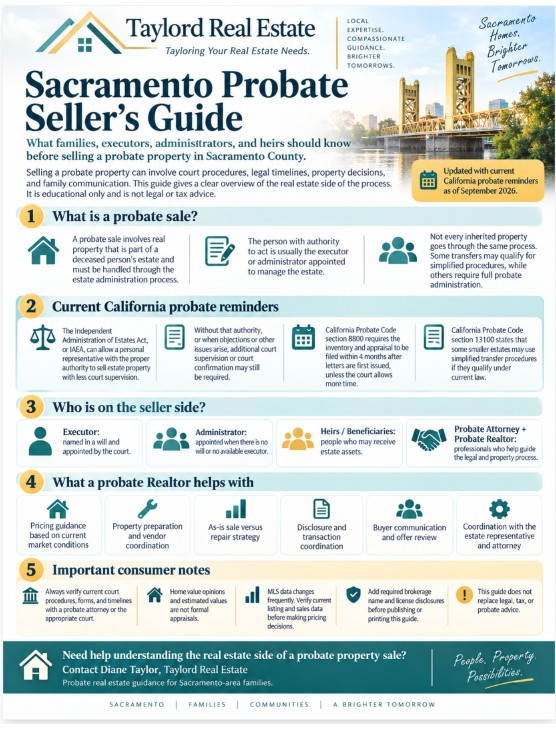
Whatever path your family is on, these two downloadable guides keep the steps straight: a one-page printable infographic for quick reference, and the Sacramento Seller's Guide for Probate & Inherited Property (October 2026) for the deep dive.

Get the Free Sacramento Seller Guides

Your name plus an email address or phone number unlocks both downloads. No spam, and no pressure: just clear next steps in your inbox.

Tell us where to send it: your name plus an email address or phone number is all we need.

No spam, ever. We only use your info to send these guides and answer your property questions.

Prefer to talk it through? Book a free consultation on the contact page, or call Diane directly at (916) 224-0482. A first conversation is always free, always kind, and never pushy.

Disclaimer: The quiz and this page are general real estate information, not legal or tax advice. Probate rules, authority, and thresholds depend on your specific situation and the date of death. For advice about your estate, consult a qualified probate attorney and your tax professional.